The night I did not dance
This month I went to the Bon dance in my own neighbourhood, and I took a camera, because I thought I knew what I would find: a wooden tower in the middle of the park, a drum on top of it, the neighbourhood in a circle. That is the Bon dance as it is usually described, and I have seen it that way many times.
There was no tower this year, and no drum. What there was, was this.
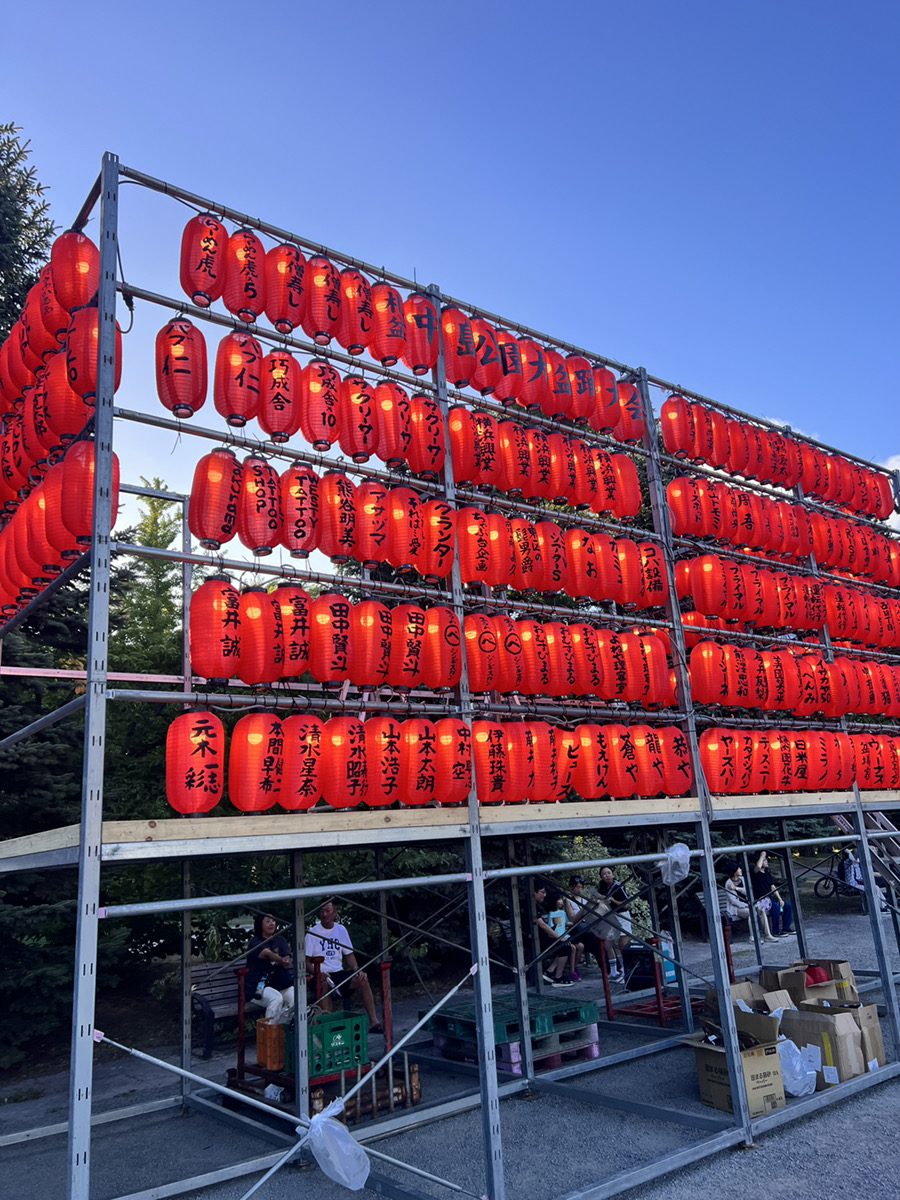
Late afternoon. Every lantern carries a name.
A wall of red lanterns, six rows high, put up on scaffolding at the edge of the ground. Each one has a name brushed on it — a family, a shop, a hair salon, a tattoo parlour, someone’s grandmother. These are the households and businesses of the neighbourhood who gave a little money to hold the dance this year, and this is how they are thanked: publicly, in ink, at eye level, in the order the money came in. It goes up in the afternoon, and by dark it is the brightest thing for a mile.
Behind it, the stalls.
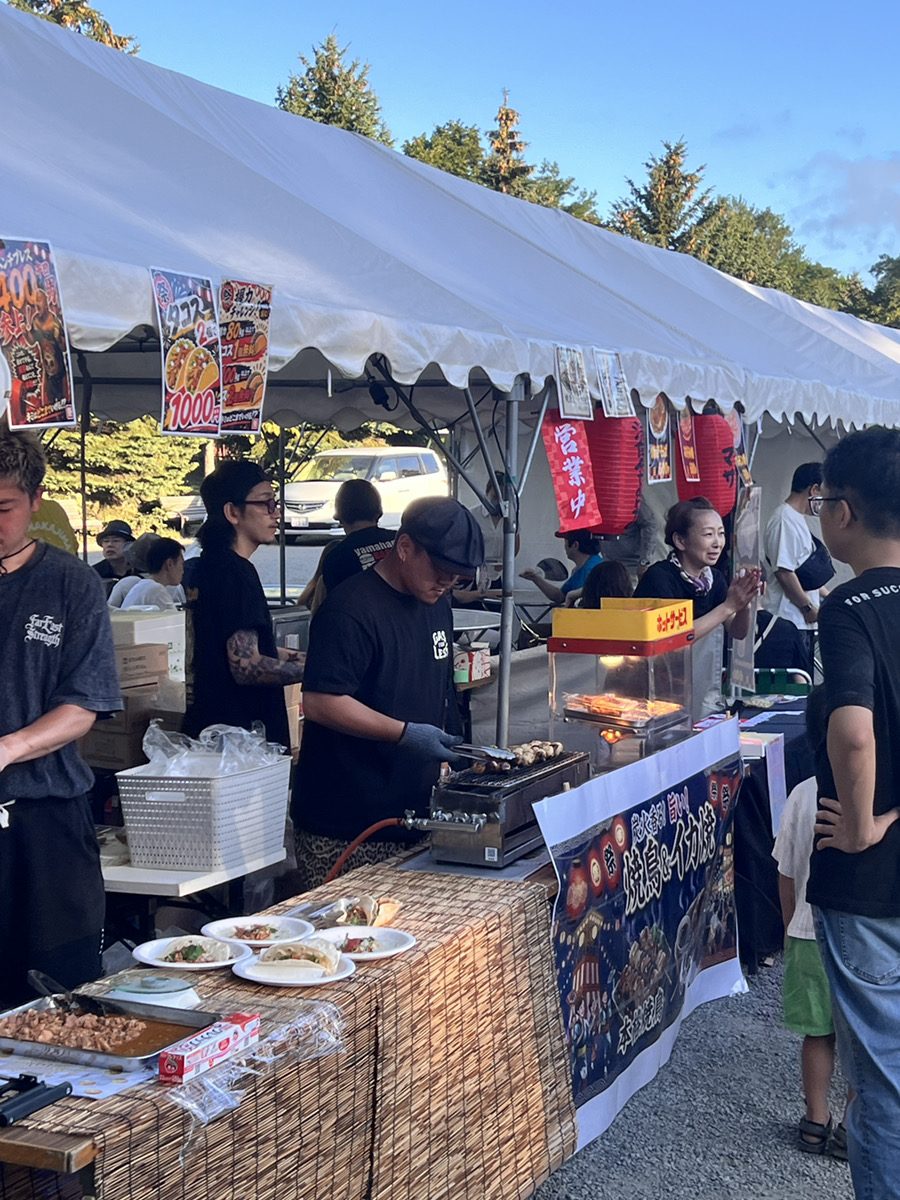
Yakitori on the grill, tacos on the plates. Nobody finds this strange.
Grilled chicken on skewers, squid, shaved ice — and, this year, tacos. I want to be honest that I noticed the tacos, and honest that no one else did. A neighbourhood festival in Japan has never been a museum. It takes whatever the neighbourhood is that year and hangs a lantern over it.
And then, when the light went, the dance.
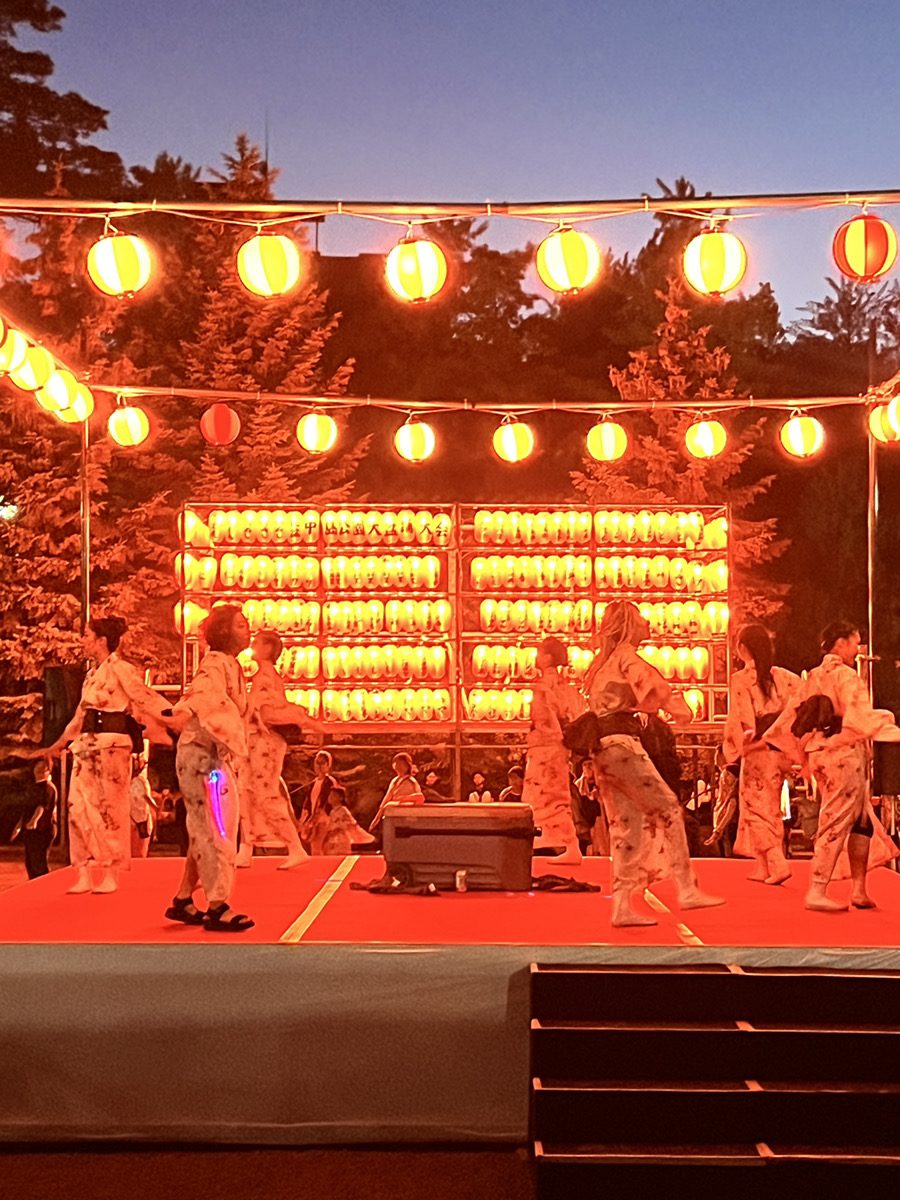
Dusk. The dancers on the stage, the wall of lanterns lit behind them.
Not a tower but a low stage, red-carpeted, with a line of women in yukata on it showing the steps, and everyone else on the ground below following. No drummer; the music came from a speaker. I had expected that to matter. It did not. The circle formed and went round, the people who had come to watch drifted into it song by song, and nobody left early. It was warm and loud and glad, in the way a room is when everyone in it already knows everyone else — which, in that park, they did. That is what a small Bon dance turns out to be for. The tower and the drum are the picture of it; the neighbourhood is the thing itself.
I brought back a few seconds of it, from earlier, while the sky was still light — the stage, the lanterns, and the people around me starting to move.
🎥 Watch — eighteen seconds of the dance
Sound on, if you can. The song is the point.
Here is what I did not know until I stood there with a camera in my hands. This is a small dance — one park, one evening. On the same evening, and the ones either side of it, the same thing was happening in parks and temple grounds and school yards across the whole city, and across the whole country: hundreds of them, most of them this size, most with a lantern wall and a speaker rather than a tower and a drum, each one paid for by the names on the lanterns. The famous ones you may have seen photographs of — the great towers, the crowds — are the exception. This is the rule. The Bon dance is not one thing that Japan does. It is a thing that every neighbourhood does, at its own size, with whatever it has.
And I did not dance. I had a camera and I had come to use it, so I stood at the edge and used it, and I chose that on purpose. I do not regret it. But I noticed — and I will tell you this because a friend recently told me one cannot be a spectator and a dancer at the same time, and she was right — that the photographs are what I have instead of the dance. They are good photographs. It was not a bad trade. It was a trade.
Next year I may leave the camera at home.
Was there a dance where you grew up — a village fête, a saint’s day, a night when the whole street was out? Write to me at hello@kurafinds.com, if you like. I read what comes.
From a Sapporo park, the lanterns down and the scaffolding gone,
Warmly,
Kei — Kura Finds